THE SOUND · ENTRY 03 OF 05
Guitar Tone With Nowhere to Hide
THE SOUND · ENTRY 03 OF 05
Strip a band down to guitar, upright bass and drums and something immediately clarifying happens: the frequency map gets divided into three zones with no overlap budget. The upright bass covers the low end — and it does so with a different tonal character than an electric bass, fuller in the upper-midrange fundamental and less present in the very low sub-bass, which means it actually competes more directly with the guitar than you might expect. The drums own the transient layer. That leaves the guitar holding everything in between, and there is no second guitar, no keys, no rhythm part doubling the chord work. Whatever tone comes out of the amp is the entire midrange picture.
This is structurally different from what happens in a conventional four or five-piece. In a band with a separate rhythm and lead guitarist, or a guitarist sitting on top of an electric bassist, tones can be chosen relative to each other. Here there is only one tone to choose, and it has to carry both functions at once — enough body to fill the midrange when playing chords, enough cut to project a lead line over the top of a percussive, slapping upright. The guitar cannot retreat behind another instrument. It is always audible, always exposed.
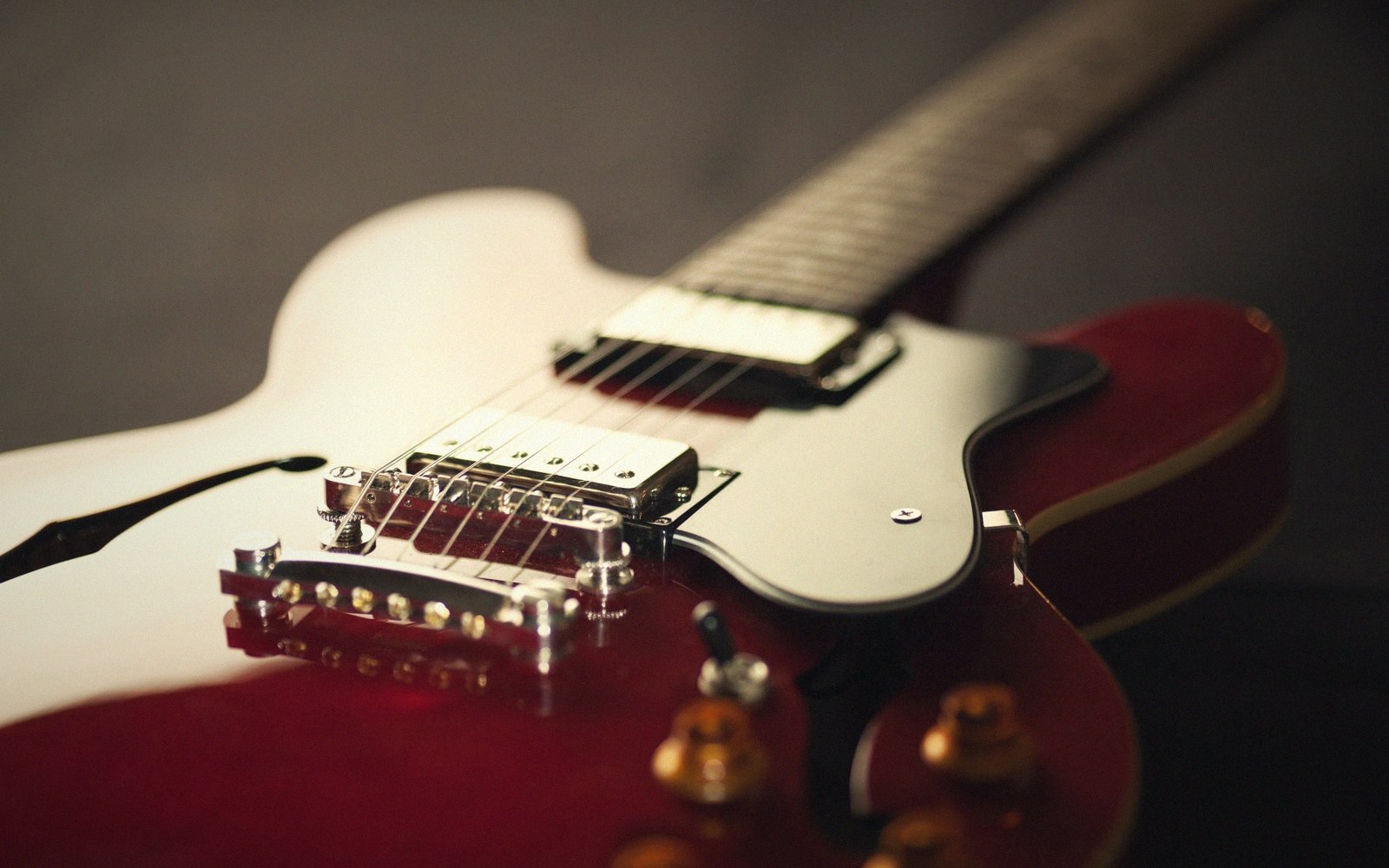
A semi-hollow or hollow-body guitar introduces a resonance character that a solid-body does not have — a natural warmth in the midrange that flatters rhythm playing and gives chords an acoustic dimension. In a three-piece with an upright, that warmth is useful because it helps the guitar sit in the midrange rather than competing with the bass's upper fundamentals through sheer volume. A guitar with a scooped tone, pushed into the low frequencies to sound "heavy," creates a pile-up with the upright that muddies everything. The hollow-body's natural EQ leans away from that collision.
But a hollow or semi-hollow guitar at volume is also a feedback system waiting to activate. The body resonates; the resonance gets picked up by the pickup; the amp reinforces it; the body resonates harder. In a studio, at controlled stage volumes, this is manageable. At the kind of venue volumes that Australian pub rock and the band-room circuit demanded — and The Living End were shaped entirely by that circuit — it becomes a working constraint rather than a background consideration. Feedback is not an effect to be triggered deliberately; it is a problem the player has to outmaneuver on every loud stage. Pickup placement, the angle of the guitar relative to the amp, the exact frequencies the amp is boosting — all of these matter more on a hollow-body at volume than on a solid-body with a humbucker and a thick mahogany slab behind it.
What this means in practice is that the tone choices — which guitar, which pickup position, how the amp is EQed, how much gain — are not separable from the compositional and arrangement choices. A guitar that feeds back at a certain frequency threshold in the hollow low-mids forces the player to compensate, either by controlling stage volume (which affects the whole room), by adjusting pickup selection (which changes the available tonal character), or by accepting that certain frequencies are simply unavailable. Those constraints shape what gets written and what gets played.
In a three-piece without another guitar to cover the midrange, there is also no hiding a tone that is not working. A guitarist in a larger band can drop back in the mix and let the blend do the work. In this configuration, a weak or muddy tone is immediately the thing the listener hears, because there is nothing else filling that register. The hollow-body, used in this context, is not a vintage aesthetic decision — or it is not only that. It is an instrument with specific acoustic properties that happen to address the specific frequency problem this band configuration creates. That the instrument looks a certain way is almost beside the point.