THE SOUND · ENTRY 01 OF 05
The Double Bass as a Punk Instrument

THE SOUND · ENTRY 01 OF 05
Nobody hauls an upright bass into a punk band by accident. The instrument is roughly the size of a wardrobe, requires a custom case that costs more than most electric basses, and has a neck radius that will punish anyone trained on electric. In a loud room it feeds back. In a van it takes up space three people might otherwise sleep in. It goes out of tune when the temperature changes between load-in and the first song. Every practical argument points toward a Fender Precision and a DI box. Choosing the upright anyway is a statement of intent, made nightly, before a note is played.
The Living End chose it and kept it. That decision is not merely cosmetic — a visual callback to Sun Records, a retro affectation — it is a structural choice that determines what the band sounds like at a physical level and what the other two members have to do. Understanding that is understanding the band.
An upright bass produces sound through a large spruce or maple top vibrating at relatively low amplitude. The projection is acoustic at its core; the pickup, whether piezo under the bridge saddle or a magnetic mounted near the fingerboard, is reading that vibration rather than replacing it. The result is a fundamentally different attack envelope compared to an electric bass: there is a pronounced transient at the start of each note — the percussive thump of fingers or slap — followed by a decay that begins almost immediately. Sustain, the quality an electric bass has in abundance, is not the upright's currency.
In a punk context that is not a limitation. It is load-bearing. The slap technique — pulling the string away from the fingerboard and releasing it back against the wood — turns each note into a snare-like crack. What would be a bass note on an electric becomes, on an upright played hard, something between a bass note and a rim shot. The instrument is doing two jobs: harmonic and percussive, simultaneously, at the bottom of the frequency register. That is why a three-piece built around an upright can sound as full as a four-piece. The bass is already supplying rhythm that the kit would otherwise carry alone.
This has real consequences for the drummer. When the bass is percussive, the kit cannot play as though it were the only rhythmic voice — and it cannot play exactly the same patterns it would behind an electric bass. The backbeat relationship shifts. The bass and kit have to negotiate subdivision rather than divide it cleanly. Get it wrong and the low end sounds cluttered; get it right and the pocket is unusually dense for three people.
The inconvenience of the thing is inseparable from the sound of it.
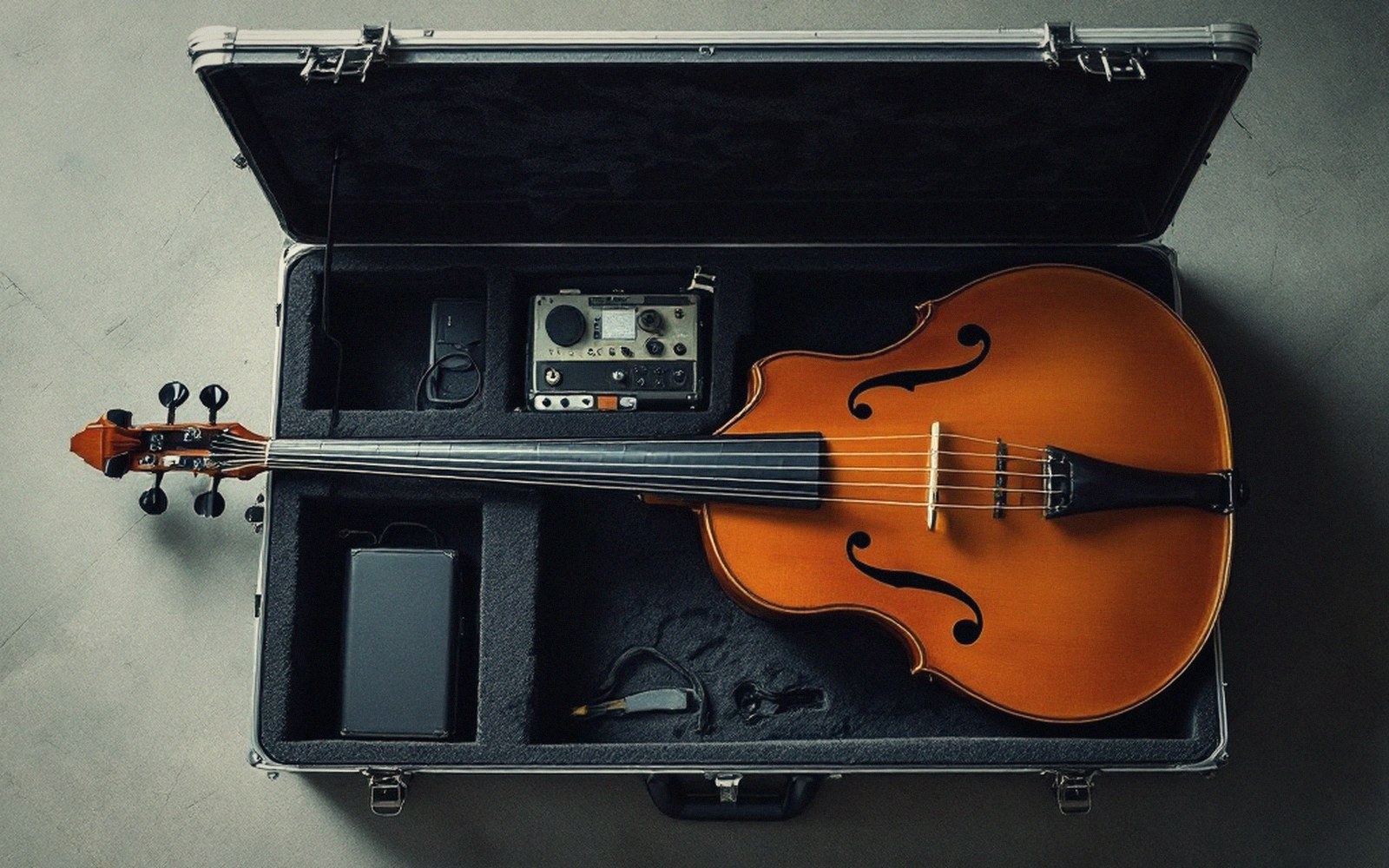
The feedback problem is real and worth understanding technically. An acoustic top vibrating at stage volume is constantly receiving low-frequency energy from the monitors and the room itself. That energy tries to drive the top further; the pickup reads the resulting vibration; the amplifier amplifies it; the monitors push more energy at the instrument. The loop is short and fast. Electric bass instruments are largely sealed against this — a slab body does not vibrate sympathetically the way a carved top does. An upright played at rock volume lives permanently closer to the edge of control.
The practical solutions are well-established: foam wedged under the tailpiece to damp sympathetic resonance; a notch filter cut in the signal chain at the instrument's resonant frequency; monitoring positioned carefully to reduce direct coupling; and, most importantly, the player using physical contact and hand position to manage the top's vibration in real time. None of this is invisible. It requires active management throughout the set. The instrument demands more from the person playing it than an electric does, constantly, in ways the audience cannot see but would hear immediately if that attention lapsed.
This is part of what makes the choice expressive. The upright in a loud band is not an instrument you can be passive with. Every note is a small negotiation between what the player intends and what the room is trying to do to the string. That alertness shows up in the playing — there is a physicality to upright bass work at volume that simply does not have an equivalent on electric. You can see it from the back of the room.
Choosing the upright for a rock band is also a positioning decision, whether the player intends it to be or not. The instrument arrives trailing a specific history: rockabilly players in the American South and Midwest in the 1950s, the slap style codified by players who needed volume before electric amplification was reliable or affordable, then the rockabilly-into-psychobilly lineage that carried those techniques through British and European bands of the 1980s, through groups who found in the instrument's aggression something compatible with punk velocity. The Stray Cats made the upright legible to a mainstream rock audience again in the early 1980s, which is a prerequisite for what the Living End later did: assuming that the instrument's vocabulary was available, and using it without quotation marks.
The Melbourne context matters here too. The pub rock inheritance in Australia emphasised directness, volume and a particular kind of physical authority on stage — qualities that an upright bass, played hard, happens to deliver. It is not a delicate instrument when played this way. It is loud, blunt and physical in the room, and those qualities fit the band-room circuit the band developed on.
In a trio, the upright bass cannot be a background instrument. There is no rhythm guitar filling mid-range, no keyboard padding out the sound underneath — the space between the bass register and the guitar's lead work is largely empty, and the bass has to make that space coherent rather than barren. This forces a playing approach that is melodically active without stepping on the guitar's frequencies. The upright, with its fast decay and percussive attack, manages this by implying line rather than sustaining it: the note lands and releases, and the ear fills in the gap. It is a conversational instrument in this context, not a monolithic one.
That conversational quality, between bass, guitar and kit, is what gives the three-piece its particular texture. The upright chose this band as much as the band chose the upright: its natural behaviour in a loud room — percussive, fast-decaying, physically demanding, historically loaded — is exactly what the music needs. The inconvenience of the thing is inseparable from the sound of it.
An unofficial fan archive. Not affiliated with, endorsed by, or connected to the band, its members, its management or its labels.