WHERE IT CAME FROM · ENTRY 01 OF 05
Rockabilly Into Psychobilly
WHERE IT CAME FROM · ENTRY 01 OF 05
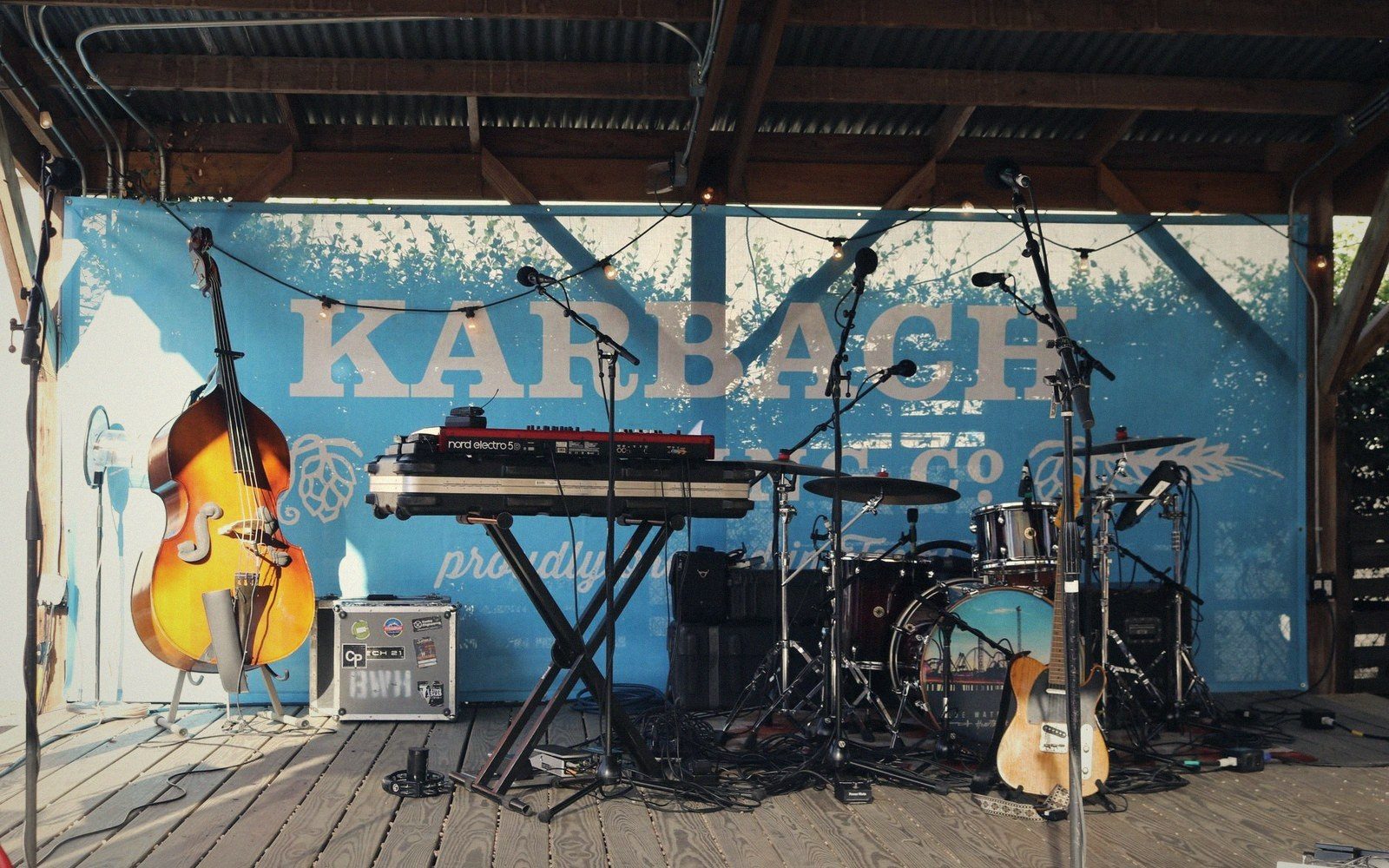
Rockabilly is not a complicated idea. You take the rhythmic drive of rhythm and blues — the riff, the backbeat, the forward momentum — and you play it with the instrumentation of country music: acoustic guitar, upright bass, sometimes steel guitar, players who came up in a tradition where the room was the amplification. The result is something light on its feet in a way that electric blues is not, and louder than country had any right to be. The key technical fact is the bass: a large acoustic instrument played with enough attack to cut through without amplification, the player slapping the strings against the fingerboard to generate a percussive crack that is simultaneously a rhythmic event and a pitch event. Sun Studio in Memphis is the canonical address for all of this — Elvis Presley, Scotty Moore and Bill Black recording in 1954 and 1955, the slapped upright bass sitting where later records would put a kick drum, the whole thing feeling like it was about to accelerate past the point of control.
What rockabilly had that would matter decades later: an upright bass doing percussion duty, a guitarist and bassist who locked into each other across a stripped-down arrangement, and a tempo that treated restraint as a bad idea. What it lacked, by the standards of what came next, was menace. Even the most aggressive early rockabilly — Gene Vincent's "Be-Bop-A-Lula," Eddie Cochran's work — has a surface optimism, a suggestion that the energy is celebratory. The darkness is there in the margins, in Vincent's strangeness, in Cochran's short life, but the music itself was sold to teenagers as fun. The next generation that picked it up was not interested in fun in the same way.
Psychobilly arrived in Britain in the early 1980s as a deliberate derangement of the rockabilly template. The Cramps, American and operating since the mid-1970s out of New York, are the most commonly cited precursor — a band that took rockabilly's instrumentation and ran it through horror-film imagery, extreme reverb, and a willingness to sound genuinely unhinged. They did not use an upright bass, but they kept the slapped bass sound as a textural reference and they kept the stripped-down lineup: two guitars (no bass guitar for stretches of their career), drums, a singer performing at the edge of parody but never quite crossing over into it. The Cramps pointed at what rockabilly could become if you took the fun out of it and replaced it with something stranger.
The British psychobilly bands of the early 1980s — most of them clustering around the Klub Foot nights at the Clarendon Hotel in Hammersmith, London — put an upright bass back into a loud band context and treated it as a provocation. The Meteors, Guana Batz, Restless, King Kurt: these bands kept the slapped upright as a defining element while absorbing the speed and aggression of punk. The tempo went up. The guitar got dirtier. The lyrical subject matter moved toward horror, outsider identity, and a kind of deliberate grotesquerie that was partly working-class in its refusal of respectability and partly just fun in a different register than 1950s rockabilly's fun. The dance that developed in psychobilly circles — the wrecking, a semi-violent form of movement concentrated at the front of the room — told you something about how the music was meant to land in a body.
The critical tension in 1980s psychobilly is between the rockabilly inheritance and the punk one. The musicians who came up in this world were often technically more rooted in rockabilly than their punk contemporaries — they had to be, because the upright bass demands more specific technique than an electric — but they were playing in rooms that the punk circuit had built and to audiences shaped by punk's ethic of volume and aggression. The result is music that can feel pulled in two directions: the rolling swing of rockabilly on one axis, the straight-ahead attack of punk on the other. How much of each axis a band occupied was a meaningful stylistic choice, whether or not the band was consciously making it.
Before Melbourne, there is a necessary detour through the Stray Cats and their early-1980s moment. The Stray Cats were not psychobilly — they were a rockabilly revival act that used the original template with enough style and production clarity to put an upright bass back on mainstream radio. Their importance for what came later is partly about technique (Lee Rocker's slap bass work was documented, widely heard, and technically clean enough to be studied) and partly about legitimacy: they demonstrated that a modern audience could hear an upright in a rock context and not think it was a novelty act. They are the hinge between the 1950s originators and the 1980s explosion, not because they were the most extreme version of anything but because they were the most visible.
The Living End do not fit cleanly into the psychobilly category, and treating them as a psychobilly band misrepresents what is interesting about their position. The psychobilly tag gets applied because of the upright bass, the tempo, and the surface energy; but the band's actual allegiances run more directly between the 1950s rockabilly source material and 1990s punk and alternative rock than through the British psychobilly circuit. The Klub Foot lineage is in the background; the foreground is Australian pub rock and a Melbourne punk scene that had its own developmental logic.
What the band kept from the rockabilly tradition is structural. The upright bass as percussion instrument — not just melodic and harmonic support but a rhythmic machine operating in parallel with the drum kit — is a direct inheritance from Bill Black's approach on those 1954 Sun recordings. The three-piece configuration, with no rhythm guitarist to fill the middle of the frequency spectrum, forces the same problem the early rockabilly players faced: everything has to be legible with fewer instruments, so each player carries more of the arrangement. The slap technique the bass player uses is a technical lineage you can trace without interruption from 1950s Memphis through 1980s London to 1990s Melbourne.
What got discarded on the way is the period specificity. Rockabilly's original charm is partly nostalgia — even at the time, it was a kind of folk memory of something just out of reach, a music that felt simultaneously new and ancient. The psychobilly bands were more interested in the energy than the nostalgia, and by the time that energy reached Melbourne it had been stripped of almost all its period costume. The Living End's debut recordings do not sound like they are performing the 1950s; they sound like a contemporary punk band that happens to use a very old instrument in a very physical way. That distinction matters. It is the difference between a revival act and a band that has absorbed an inheritance and moved past it.
The deeper question the lineage raises is one of genre politics. Psychobilly as a category was built partly on opposition — to mainstream rock, to polished production, to any implication that the music was trying to be respectable. A band that achieves mainstream success while carrying the genre's instruments and energy is inherently in tension with that opposition. The British psychobilly world largely stayed underground; the Stray Cats achieved commercial success but in a deliberately retro-nostalgic register that let the mainstream absorb them without feeling threatened. A band trying to be a serious rock band with an upright bass in the late 1990s was occupying a stranger position: the instrument signified a tradition, but the band's actual ambition was forward-looking.
That tension between the rockabilly-into-psychobilly lineage and the desire to be a contemporary rock band is, arguably, what makes the first two records worth returning to. The constraint is generative. The upright bass cannot do what an electric bass guitar can do — it cannot be mixed into the bottom of a dense arrangement and forgotten about, it will not sit quietly under a wall of guitar overdubs, it forces the music to stay relatively open. That openness is a rockabilly inheritance even when nothing else about the song sounds like 1954. The chain from Sun Studio runs forward through Hammersmith and across the Pacific, and it arrives in Melbourne not as costume but as a set of genuine constraints that shape what the music is allowed to do.
An unofficial fan archive. Not affiliated with, endorsed by, or connected to the band, its members, its management or its labels.