THE RECORDS · ENTRY 03 OF 05
Modern Artillery
THE RECORDS · ENTRY 03 OF 05
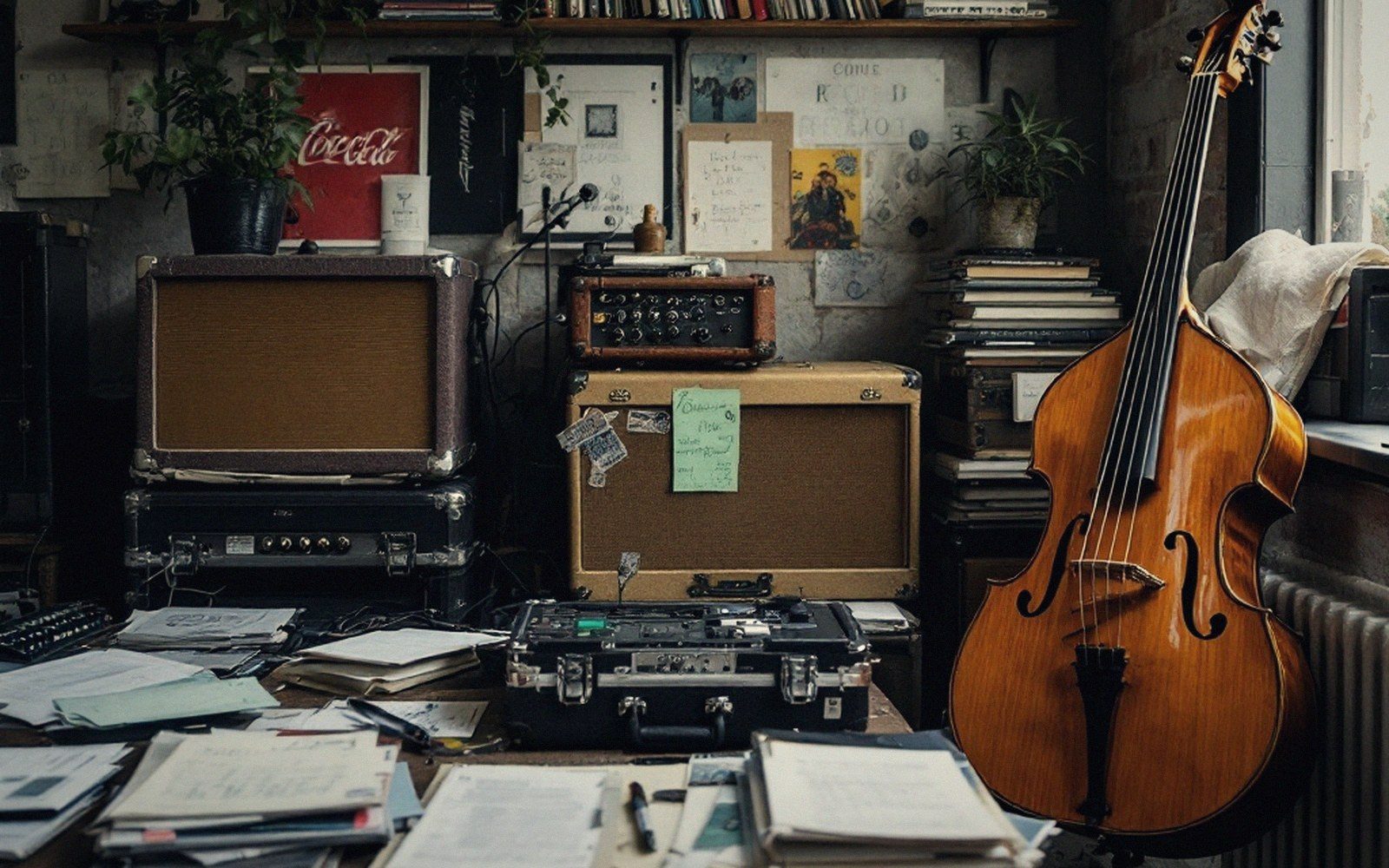
Modern Artillery arrived in 2003 as the third full-length from a band that had built its entire appeal on a sound rooted in physical presence — an upright bass, a hollow-body guitar, a drum kit, and enough room ambience to hear all three fighting for space. The record represents a real departure in production approach, and it is worth discussing on those terms rather than as a simple fall from grace or a smart commercial pivot. Both of those framings flatten what is actually an interesting case study in what happens when a three-piece stops sounding like three people and starts sounding like a record.
The shift is audible within the first moments of the album. Where the debut's production let the instruments breathe against each other — the double bass sitting in a register that overlapped with the guitar's low end, creating that slightly congested, pressurised feel — Modern Artillery separates everything out more cleanly. The bass sits lower, the guitar sits higher, and the whole thing feels more spacious in a way that is technically correct and emotionally cooler. Frequencies that used to collide are now managed. That collision was not a flaw; it was a large part of how the band felt urgent.
Production on a record like this is not just reverb and compression settings. It is decisions about how many tracks of guitar to stack, whether to double a vocal, how much the drums get to bleed into the room microphones, and whether the bass is recorded with the same kind of proximity that makes a live upright feel physically threatening. Modern Artillery makes choices on all of these that lean toward legibility over physicality. Each instrument is more present and more isolated. The record is easier to listen to in the way that a photograph with the exposure corrected is easier to look at, and it loses some of the same quality — the evidence of conditions.
This matters more for this particular band than it would for a four- or five-piece, because in a three-piece setup the interaction between instruments is the sound. There is no rhythm guitarist filling the middle frequencies while the lead plays over the top. There is no keyboard underneath smoothing transitions. What happens between the upright bass and the guitar is not texture; it is structure. When production separates those two instruments too cleanly, it does not just change the sound — it changes the structural logic of how the band generates energy.
The slap technique on the upright becomes a different proposition in this context as well. On earlier records, the slap registered as a percussive event that sat inside a dense mix, adding attack to an already busy sound. On Modern Artillery, with more separation, it registers more clearly as a technique being deployed, which is a subtle but real difference. You hear the craft more and feel the intention less.
None of this is to say the album fails outright, and that verdict would be too easy anyway. The song writing on Modern Artillery has moments of real economy — the melodic instincts that made the singles on earlier records stick are still functioning, and a clean production can serve a strong melody in ways that a dense one cannot. Several tracks here demonstrate that the band understood how to construct a hook that would survive the tidying-up.
The tempo choices across the record are also worth noting. The Living End had always used tempo as a tension device — a song that holds slightly too long at a slower pace before the break arrives creates an anticipation that a mid-paced rock record often cannot. Modern Artillery still deploys this, and the rhythm section still communicates the way a unit that has played together for years does: the drummer and the upright bass player are not simply keeping time but negotiating it in real time, which is something that even a polished production cannot fully erase.
What the record ultimately demonstrates is the risk specific to bands whose identity is tied to a particular sonic relationship between their instruments. A bigger production does not necessarily betray the songs; it can betray the band's physics. The three-piece whose appeal rests on the feeling that the sound could get out of control at any moment — that the double bass is too loud, that the guitar is feeding back in a useful way, that the drummer is hitting harder than the room can absorb — has something to lose from a production that removes those risks. Modern Artillery is a record that removed some of those risks and got a more composed, less electrically alive result.
Whether that trade was worth making depends on what you think a record is supposed to do: capture a band performing, or present a band's songs in the most accessible form. Those are not the same project, and the tension between them is exactly what makes Modern Artillery worth arguing about, even now.