THE CIRCUIT · ENTRY 04 OF 04
Festival Stages Versus Band Rooms
THE CIRCUIT · ENTRY 04 OF 04
A band room in an Australian pub is a specific acoustic event. The ceiling is low, the PA drives into a space that bounces everything back, and the crowd stands close enough that the bass is felt through the floor before it is heard through the speakers. The Living End built their sound in those rooms — three people, a loud guitar, a kit, and an upright bass being slapped hard enough to register as a percussion instrument. The physics of that environment are part of the arrangement.
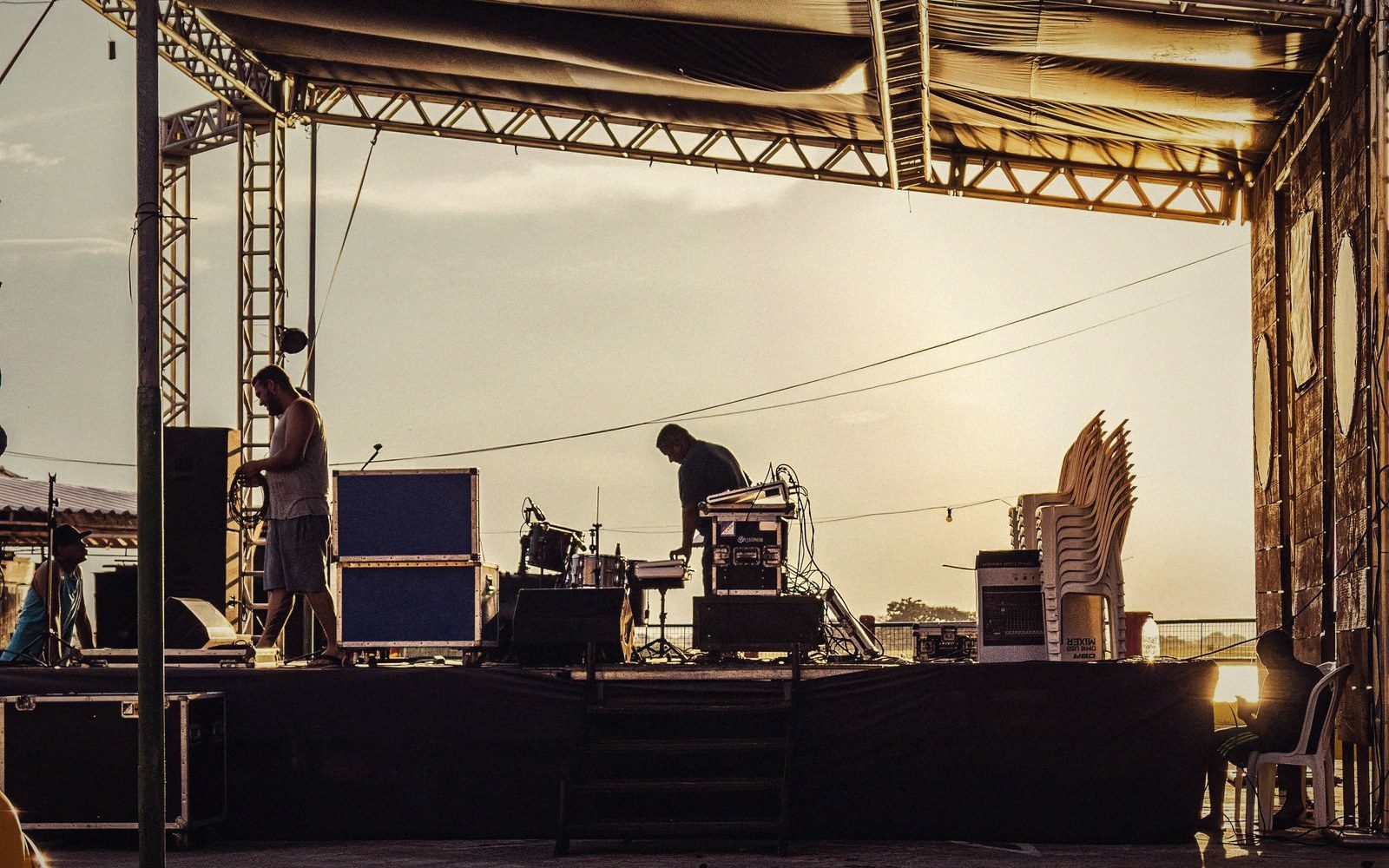
A festival stage dissolves most of those physics. The ceiling becomes the sky. The PA pushes sound into open air where it simply leaves rather than bouncing back. The crowd stands anywhere from the barrier to two hundred metres away, receiving a mix that has been travelling long enough to smear. The monitor system is now the only thing telling the players what they are actually doing. And the upright bass — already a difficult instrument to project cleanly at loud volumes — becomes a problem that the monitor engineer has to solve in the minutes between changeover and downbeat.
In a band room, the double bass reinforces itself. The body resonates, the room resonates with it, and the slap produces a transient that everyone in the space catches simultaneously. A festival monitor wedge produces a representation of that sound, not the thing itself. The physical impulse — the compression in the chest, the floorboard vibration — is gone. What remains is a reproduced signal, and a reproduced upright bass sounds thinner than the real one even at high volume, because the signal captured by the pickup or microphone is never the full acoustic event.
The result is that a bassist used to playing against a room is now playing against a wedge or in-ear feed, making micro-adjustments based on something that does not behave like the instrument. Timing shifts. The slap technique, which works partly because the player feels the rebound, loses its tactile feedback loop. Songs built around the rhythmic interlock of slap bass and a backbeat depend on that feedback more than they appear to on a recording.
The guitar faces a different but related problem. In a pub band room, a loud amplifier in a small space creates a sustain and harmonic bloom that the player uses as part of the sound. On a festival stage, the amp is behind the player and the open air takes the sound away. The character of the guitar part changes — edges get harder, the bloom disappears, and the frequency space that usually accommodates itself now has to be managed consciously rather than left to the room.
The songs that hold up on a festival stage are the ones with the most external momentum — fast tempos, changes that arrive before the listener has time to get lost in the mix smear, and arrangements where the melodic hook is so direct that degraded audio does not obscure it. A song like "Prisoner of Society" survives at two hundred metres because the hook is simple and relentless enough to work under almost any conditions. The tempo does the work.
Slower or more dynamic material fares worse. A song that depends on contrast — a quiet section that makes the loud section hit — loses that contrast on an open-air stage because the quiet section does not register as quiet to a crowd at distance; it registers as distant and difficult to hear. The dynamic range that reads as drama in a band room reads as a sound problem in a field.
This is not a criticism specific to this band. It is a structural fact about the translation from a tight acoustic space to an open one, and it affects every band built for the former when asked to play the latter. What changes is whether the songwriting was designed with enough brute-force momentum to survive the translation. For a catalogue built on slap-driven three-piece rockabilly-punk, the songs that were always about speed and volume arrive intact. The ones that were about the room are the casualties.