THE CIRCUIT · ENTRY 01 OF 04
Anatomy of a Pub Band Room
THE CIRCUIT · ENTRY 01 OF 04
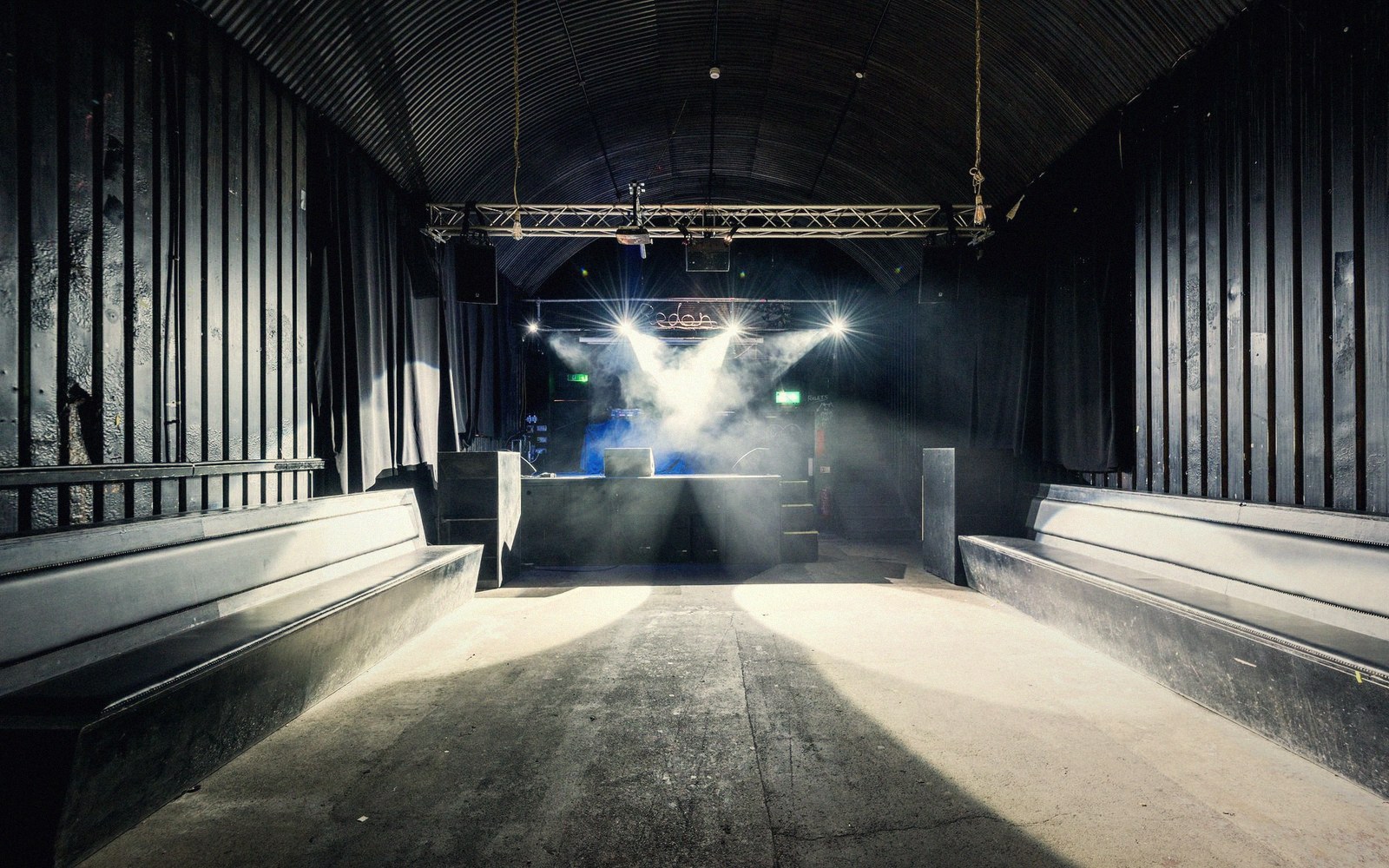
Walk into any of the venues that shaped Australian rock between the 1970s and the mid-2000s and you are standing inside a piece of infrastructure as specific to its purpose as a velodrome. The dimensions were not designed around acoustics. They were designed around alcohol licensing law, fire egress, the dimensions of a standard commercial lease, and the need to fit a bar, a stage, and two hundred people into a building that was built to serve parmas and schooners. The fact that bands sounded good in some of these rooms, and extraordinary in a few of them, was partly luck, partly adaptation, and partly the result of musicians learning to work with a set of constraints they could not change.
The Australian pub room is an architectural type with recognisable features. Understanding those features is not an academic exercise. It tells you why certain bands developed the way they did, why volume was not an aesthetic choice so much as a technical requirement, and why a band that built its sound in rooms like these carries the shape of those rooms in the music long after it has left them.
The canonical pub band room is roughly rectangular, with the stage at one of the short ends and the bar running along one of the long walls or across the far end from the stage. This layout is not accidental. The bar stays visible from the entrance, the stage anchors the far wall, and the audience fills the rectangle between them. In practice, the geometry means the first ten rows are looking straight at the stage while everyone past halfway is looking at the back of someone else's head and a row of taps.
The ceiling is low — often lower than the PA needs it to be, almost never treated with any acoustic absorption beyond carpet on the floor and the bodies of the crowd. What this produces is a first reflection off the ceiling that arrives at the listener's ears so quickly after the direct sound that it is perceived not as an echo but as a change in the quality of the source: a fattening of the midrange, a smearing of transients, a particular kind of reverberant bloom that recording engineers spend years trying to either recreate or avoid. The room does not have reverb in the concert-hall sense. It has a quality closer to a large bathroom: frequencies pile up, sustain longer than they should, and the distinction between instruments in a mix blurs under load.
The corner stage is a specific variant worth noting separately. In rooms where the stage is set into one corner rather than centered on a wall, the band is playing into a room with two walls immediately behind it. The corner loading effect is real: low frequencies are reinforced by the two reflective surfaces meeting at ninety degrees, which means the bass — any bass, but an upright bass in particular — is louder in that corner than it would be three metres into the room. A band that develops its sound in a corner stage learns, consciously or not, to sit the bass back in the mix relative to what a recording engineer would expect. When that band goes into a studio, the instinct can work against clarity.
The bar at the back of the room creates a secondary acoustic reflector. Sound from the PA travels down the length of the room, hits the bar's hard surfaces — tile, glass, mirror, stainless steel — and sends a delayed return back toward the stage. The delay is long enough to be perceived as a distinct echo by the band on stage, which is why in-ear monitoring and even wedge monitors in pub rooms are fighting not just stage volume from the band but a late reflection from the other end of the room. The musicians hear themselves twice. They adjust their playing, without knowing it, to make both images cohere: this usually means slower attack, harder pick or bow pressure, and a tendency to play in the pocket rather than ahead of it.
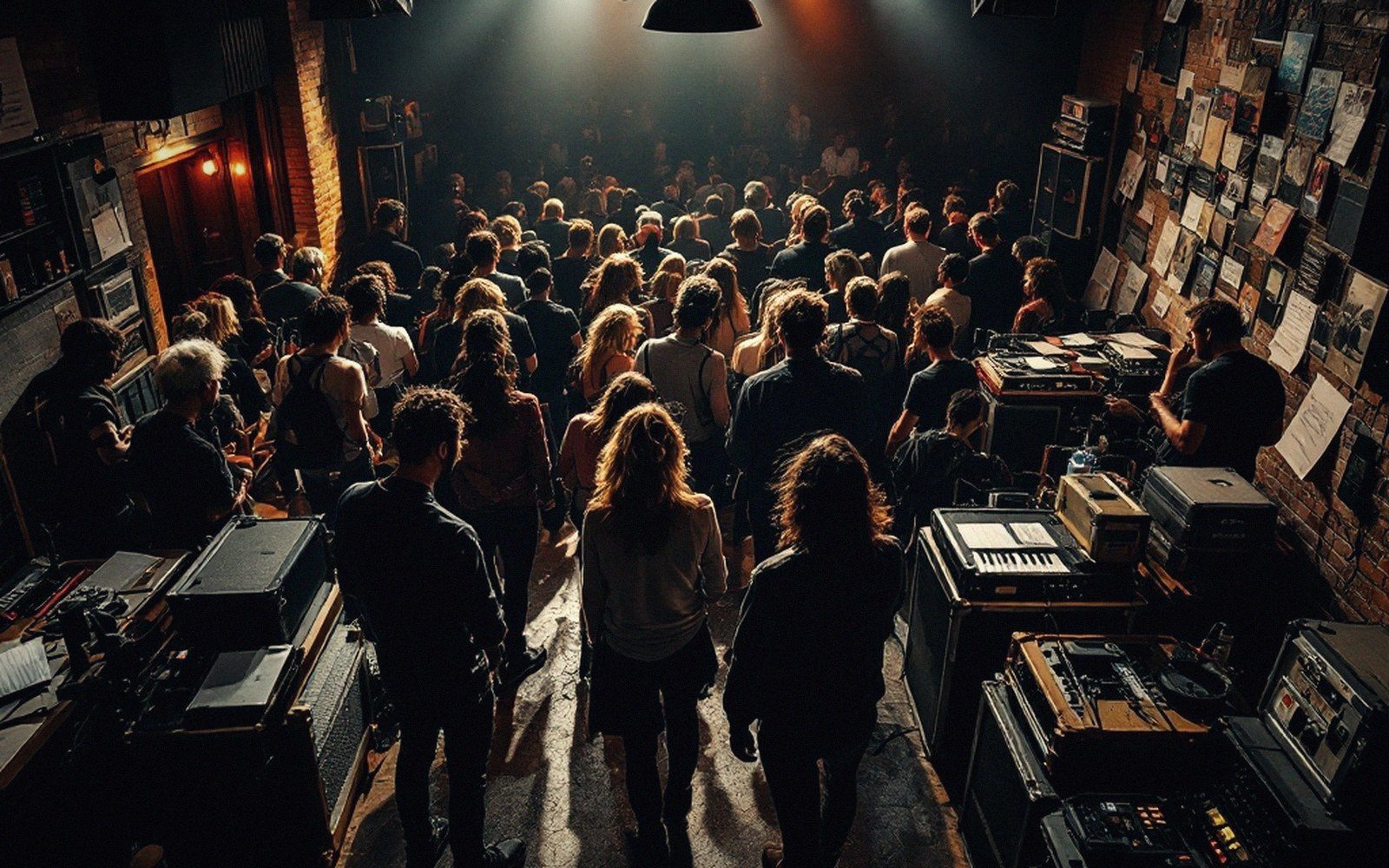
The most important variable in any pub room is not the PA, the stage height, or the ceiling tiles. It is the number of people in the room and where they are standing.
A pub band room with two hundred people in it sounds nothing like the same room with forty. Human bodies are broadband absorbers. They take the high-frequency edge off the direct sound, they dampen the ceiling reflections by filling the space through which those reflections must travel, and they raise the ambient noise floor enough that the band must push harder to achieve the same apparent volume. A crowd is acoustic treatment in motion, repositioning itself through the night, clustering near the bar early and near the stage later as the evening progresses, changing the room's response curve in real time.
This is why the sound during soundcheck — typically in an empty or near-empty room in the afternoon — bears so little relationship to the sound at peak capacity. Engineers working pub rooms learn to set the PA conservatively in the empty room and trust that the physics of the crowd will tighten the sound up at showtime. Bands who have not yet absorbed this lesson spend the first song of every set wondering why everything sounds wrong.
For a three-piece playing without a second guitar or keyboard — as a band built around upright bass, guitar, and drums necessarily does — the crowd variable is particularly consequential. The harmonic space in the mix is thin by design; the room and the audience are doing some of the work of filling it. At low capacity, the absence of a second instrument is audible as a gap. At full capacity, the reflection and absorption patterns tighten the sound around the three voices in a way that makes the sparseness feel like precision. The pub rock inheritance is in part an inheritance of exactly this phenomenon: bands built for full rooms, playing arrangements that only cohere when two hundred bodies are doing their part.
Pub stage heights vary considerably, but the common range sits between half a metre and a metre off the floor. This is high enough to lift the band into the sightlines of the crowd standing ten or fifteen rows back, low enough that the ceiling above the stage remains the same low ceiling it is over the rest of the room.
For a band with an upright bass, stage height creates a specific problem. The instrument stands at roughly 185 centimetres to the top of the scroll. Place a bassist behind the instrument on a stage with barely two metres of ceiling clearance and the neck of the bass is occupying a significant proportion of what little vertical space exists above the stage. In rooms where the PA hangs from the ceiling rather than sitting on floor stands — the more common configuration in rooms where space is at a premium — the bass can block a mid-high speaker cluster, creating a shadow on one side of the room. This is not a hypothetical; it is a recurring negotiation in load-in for any band touring this configuration, and it affects where on stage the bassist stands and how close the PA cluster hangs.
The load-in logistics of a double bass in a pub room extend beyond the ceiling. The instrument travels in a case large enough to be a problem at any stage door not purpose-built for freight. Most pub stage doors are not. The alley access points, the service corridors, and the right-angle turns behind the stage are infrastructure designed for kegs and crate stacks, and a bass case will not navigate all of them upright. These are not complaints so much as features of the environment: they impose a physical discipline on any band that insists on the instrument.
The pub room is not a neutral space for music to occur in. It is an active participant in the sound, the arrangement, and — over years of playing — the compositional instincts of the bands that form inside it. Short sentences in the music, hard endings, riffs that begin on the beat rather than before it: these are adaptations to a reflective room with a variable crowd and a ceiling that muddles anything with too much sustain. The two-chord structures, the reliance on rhythm over harmony, the economy with dynamics in the verses: all of it makes more sense when you account for the room.
A band that cut its teeth on that circuit carries the room in its DNA in the same way that New Orleans bands carry a second-line shuffle or Chicago blues carries the stop-time break. The room taught patience with volume, aggression with rhythm, and a specific relationship between the bass and the kick drum that mixing engineers sometimes struggle to understand because they did not hear it in the room where it was made.